Table of Contents
If you have sleep apnea, the right pressure device is usually either a CPAP or a BiPAP machine. For most people with mild to moderate obstructive sleep apnea, a CPAP is enough. Many people who struggle with breathing, lung issues, or cannot tolerate CPAP pressure well may need a BiPAP instead.
What CPAP and BiPAP actually are
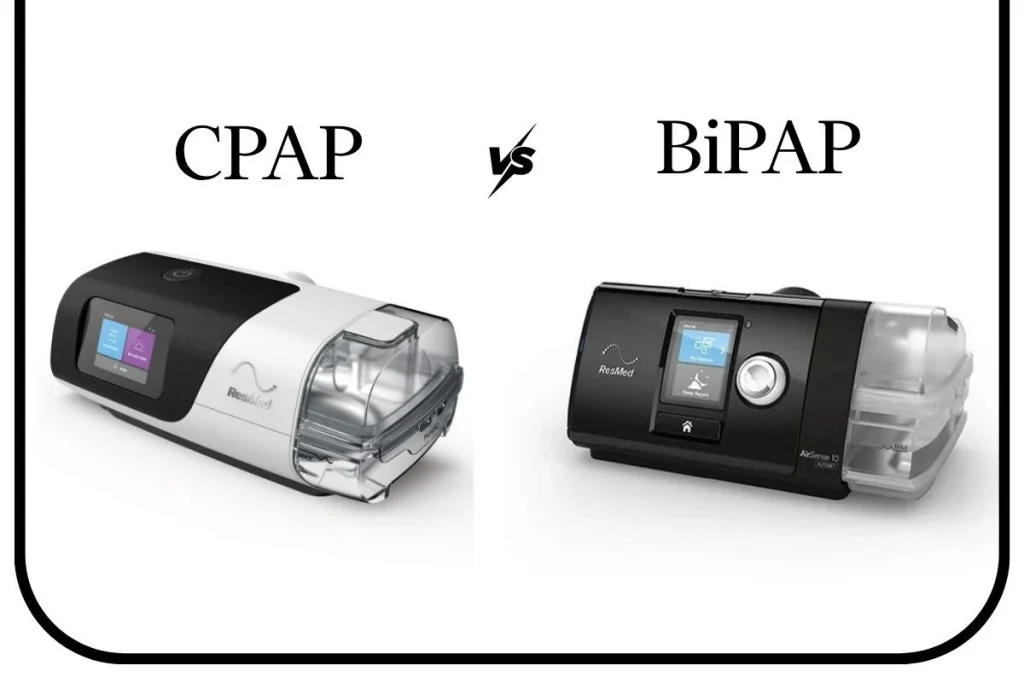
CPAP (Continuous Positive Airway Pressure) device which pushes a constant, set pressure air through a mask and keeps the throat open while you sleep. It is the most common treatment for obstructive sleep apnea as it effectively prevents the collapses that cause breathing pauses and low oxygen.
A BiPAP (Bilevel Positive Airway Pressure) machine also delivers pressurized air, but this is at two different pressures — one for inhalation (higher), and one exhalation pressure (lower). It makes each breath feel more normalized, this split works quite well particularly if you are requiring higher pressures and/or have issues with the lungs or perhaps your heart.
In practice, both are forms of PAP therapy; the real question is whether one constant pressure or two brings your breathing pattern and comfort level into alignment with your medical needs.
How CPAP works and who it fits best
CPAP is like a splint for your airway you cannot see. The constant pressure prevents the tissues from collapsing in on themselves while you sleep, reducing or eliminating your breath stoppages, snore episodes and oxygen drops. Research supports that CPAP machine benefits go beyond sleep, improving energy, mood, and long‑term cardiovascular health.
Generally, adult patients with obstructive sleep apnea are first treated with a CPAP because it is easy to provide and well-studied, and for most patients, it works. Research indicates that CPAP enhances sleep, alleviates daytime fatigue, and decreases danger of chronic conditions such as hypertension and heart disease.
Well-fitted mask, committed to nightly therapy: in our experience the biggest changes in symptoms are for those who have mild to moderate apnea. Its what most customers tell us, after the first week getting used to the sound and pressure they notice less snoring, more energetic in the mornings and no headaches anymore.
How BiPAP works and when it helps more
BiPAP changes the pressure it provides according to your breathing phase. It ramps up when you inhale so that you are not forced to blow against a wall of air. It drops a little on each exhale, so every breath is more effortless. This is especially useful for very high pressures and/or if a single CPAP level feels air hungry.
BiPAP typically is used for people who have both obstructive sleep apnea and additional respiratory conditions, including: chronic lung disease; obesity-hypoventilation syndrome; and heart failure. For specific patients with these conditions, it is suggested that BiPAP provides increased comfort whilst also assisting with carbon dioxide clearance and breathing effort.
Clinically, in a person with COPD, it is not necessarily the case that BiPAP its just “better” than CPAP; it would be a different tool for different breathing patterns. When someone is unable to tolerate CPAP or still has breathing problems with it, a sleep specialist may trial BiPAP to determine if split pressures would improve comfort and adherence to therapy.
If you often ignore loud snoring, it’s important to understand the difference between snoring and sleep apnea before it affects your health. Read our detailed guide on Snoring vs Sleep Apnea to learn the warning signs, causes, and treatment options.
Key differences: pressure, comfort, and use cases
CPAP uses one continuous pressure throughout the night. That makes the machine simpler and usually cheaper, both in upfront cost and maintenance. For people who only need a modest pressure to stay open, CPAP is often enough. BiPAP vs CPAP for Sleep Apnea also highlights a key CPAP vs BiPAP pressure difference — CPAP sticks to one level, while BiPAP offers two, making breathing feel smoother at higher settings.
BiPAP uses two pressures, which may feel more natural when breathing at higher settings. Other systems provide additional capabilities such as ramp‑up modes, automatic pressure adjustments and leak‑compensation that may be helpful for patients who awaken frequently during the night or exhibit complex breathing patterns.
From our experience, there are folks who say “I feel like I’m trying to gasp uphill with the CPAP” that do just fine on the BiPAP as long this is fairly well set up. Alternatively, CPAP unit is quite basic and patients who only require a moderate pressure feel that BiPAP would be too excessive for them and opt to use CPAP instead—if they can manage with the same.
When someone truly needs BiPAP instead of CPAP
A BiPAP is usually recommended if one or more of the following are true:
- You need a high pressure to keep your airway open, and CPAP feels too hard to breathe against.
- You have lung disease, neuromuscular weakness, or heart failure that makes exhaling against constant pressure difficult.
- You have trouble clearing carbon dioxide or tend to under‑breathe even when using CPAP.
In practice, when a patient struggles with CPAP, clinicians may reassess whether BiPAP vs CPAP for Sleep Apnea is the right contrast for their case. BiPAP machine for Sleep Apnea often becomes the preferred option when CPAP alone cannot balance comfort and breathing support.
Common mistakes people make when choosing
One of the most common mistakes is trying to pick CPAP or BiPAP based on comfort during a single night in the store or online video. Many people give up too early if they feel pressure or discomfort in the first week, when the body usually adapts after a few nights of consistent use.
A second error is to believe that using BiPAP instead of CPAP would prove advantageous simply on account of technological superiority. Some common with BiPAP well-meaning individuals have purchased BiPAP to improve their comfort, only to discover that the poor mask fit, incorrect pressure settings, or mask leaks are still causing problems. However, in our experience, this often resolves by making adjustments to mask choice, strap tension and/or pressure support rather than needing to switch machines.
Third is self‑prescription based on an article you found online, or the setup your friend swears will change your life. No two breathing patterns, anatomy or pressure needs are alike. Your CPAP settings work for one person yet may seem unbearable to another, and BiPAP’s the same way.
How to tell which one is right for you
The most reliable way to decide is through a medical evaluation and a sleep study, not guesswork. The question “Which is better CPAP or BiPAP?” does not have a universal answer; it depends on your pressure needs, breathing pattern, and comfort.
Usually, CPAP is the first treatment because it is the most common effective solution for many people. But misplaced relative to lung mechanics or with evidence prompting intolerance sense of CO2 burden, one would use an BiPAP after optimizing CPAP for tolerance and breath stability.
In our experience supporting people with pressure therapy, the main issue affecting long-term benefit is not if the device is CPAP or BiPAP; whether the settings are correct; whether an appropriate machine has been chosen and good mask fit undertaken but providing sufficient education, advice and follow-up support.
FAQ's
Is BiPAP better than CPAP for everyone with sleep apnea?
No, BiPAP is not better for everyone; it represents a different alternative for those specific breathing patterns and the medical needs. In most cases of uncomplicated obstructive sleep apnea, CPAP works well and is often the treatment of choice. The difference between CPAP and BiPAP is not about “better” but about matching the right pressure pattern to the patient.
Which machine is easier to breathe through?
Most patients also find that BiPAP is also easier to breathe through, as it reduces pressure when they breathe out thus the air does not feel like its pushing on them as much. Unlike BiPAP, which varies pressure on inhale and exhale, CPAP uses the same one-pressure-fits-all formula. That said, once they receive the correct masks and pressure, many patients adjust well to CPAP.
Do I need BiPAP if I have heart or lung disease?
Not automatically, but those conditions raise the chances that BiPAP will be considered. People with chronic lung disease, obesity‑hypoventilation syndrome, or heart failure often have trouble clearing carbon dioxide or breathing against constant pressure, so a bilevel device can feel more natural. A sleep or respiratory specialist has to review your specific test results before deciding.
Can CPAP treat complex sleep apnea or central apnea?
CPAP can treat obstructive events, but it may not fully address central or mixed apnea where the brain briefly stops signaling to breathe. In some complex cases, adaptive or bilevel devices that adjust pressure based on breathing patterns are used instead of plain CPAP. A clinician usually detects this during a sleep study and may recommend a different type of PAP therapy.
How much more expensive is BiPAP than CPAP?
BiPAP machines are usually more expensive to buy and may cost more to maintain because they are more complex. Exact prices vary by brand and insurance, but in many setups the BiPAP is noticeably pricier than a basic CPAP. However, for some patients the improved comfort and breathing support can justify the extra cost if it leads to better long‑term adherence.
Can I switch from CPAP to BiPAP and then back again?
Many people trial CPAP first and then switch to BiPAP if they still have trouble breathing or feel uncomfortable. Others find that BiPAP feels too complex or expensive and choose to stay on CPAP once it is adjusted correctly. The decision should be based on your symptoms, breathing tests, and guidance from a clinician rather than a one‑time impression.
Does BiPAP cure sleep apnea?
Neither CPAP nor BiPAP cures sleep apnea; they manage it by keeping the airway open or supporting breathing while you use the device. Stopping therapy usually means symptoms, breathing pauses, and related health risks return. Both devices are long‑term treatments, not cures.
Can I travel with a BiPAP the same way as with CPAP?
Most modern BiPAP machines are designed to be portable, with similar or larger batteries than CPAP devices. They can be carried on planes, used in hotels, and powered by adapters or external batteries. However, BiPAP units are often bulkier and heavier, so travelers should check size, weight, power requirements, and airline rules before trips.
Shop Related Products
If you are exploring CPAP or BiPAP therapy, you will likely need a pressure device, mask, tubing, filters, and cleaning supplies. Proper mask fit and maintenance are just as important as choosing between CPAP and BiPAP because leaks, skin irritation, or poor hygiene can undermine even the best machine. Explore our range of machines, masks, and accessories to support your prescribed therapy in Cpaprx.com.
Resources & Further Reading
- American Academy of Sleep Medicine – Sleep Apnea Overview
- Mayo Clinic – Sleep Apnea: Diagnosis and Treatment
- National Heart, Lung, and Blood Institute – What Is Sleep Apnea?
PubMed – Comparison of CPAP and BiPAP in selected patient groups - Sleep Foundation – BiPAP vs. CPAP Machines