Table of Contents
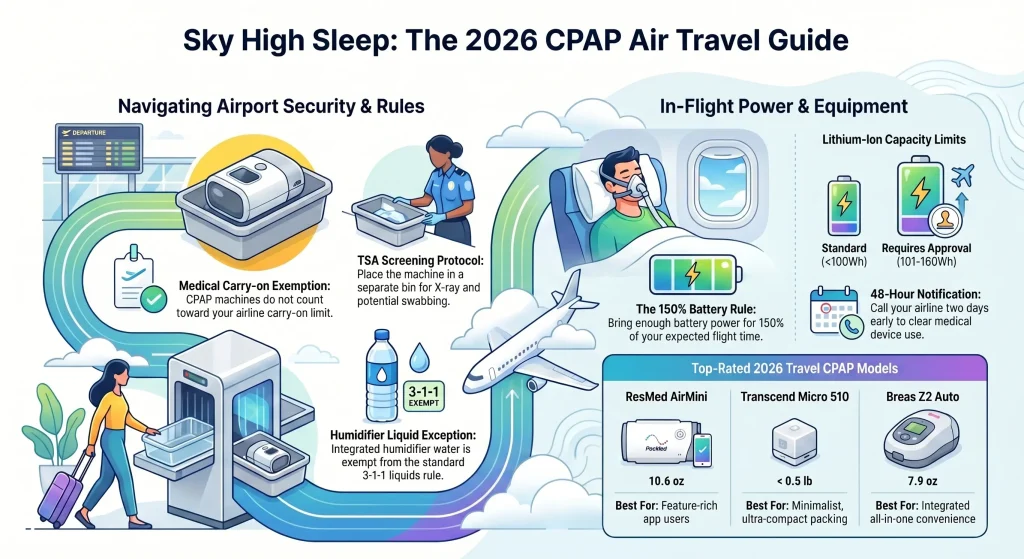
The good news is yes — you are allowed to fly with a CPAP machine, and the TSA categorizes it as medical equipment so it does not count towards your carry-on limit. No, you won’t be required to give a doctor’s letter at security–but having one on hand preempts being asked by the airline or at the gate.
Once you know the rules, the power options and which travel machines are even worth buying in 2026 flying with CPAP becomes a whole lot easier. In this guide, we’ll outline everything from TSA screening and in-flight use to battery planning, packing tips, and our top travel CPAP picks for frequent fliers.
CPAP Airport Security Rules — What TSA Requires
The TSA rule is straightforward: A CPAP device can be considered a medical device and therefore should pass through checkpoint security on its own differently from your general bag, just as a laptop would. TSA and travel-health sources also said that the machine may be swabbed for residue of explosives, a common practice considering how an x-ray machine is made.
If it is integrated into the device, your CPAP humidifier reservoir does not fall under the typical 3-1-1 liquids rule. But if you carry a separate bottle of distilled water to use in it, that will still have to abide by normal liquid regulations through security screening.
In actual practice, the most straightforward solution is to completely remove all/most of the water in the chamber just before you leave home and purchase distilled water after you land.
You do not have to take out the tubing, mask, and accessories one by one but keeping them organized can make screening faster! While TSA does not ask that you provide a doctor letter at the checkpoint, some airlines and foreign countries do require documentation of prescription for flying, so it is wise to carry a copy of your prescription or medical note.
Quick TSA Checklist
- Carry your CPAP in the cabin, never in checked baggage.
- Remove the machine from the bag for screening if asked.
- Empty the humidifier chamber before leaving home.
- Keep your prescription or doctor’s note in your travel folder.
Can You Use a CPAP on a Plane?
Yes, many airlines permit in-seat CPAP use but you must check with the airline policy ahead of time as this varies by airline. A well-established best practice is to call the airline (ideally) at least 2 days before flying and, depending on the carrier, ideally longer than that for medical-device clearance and seat assignments.
Power matters depending on which aircraft you are on and what seat class. While select premium seating is equipped with AC outlets, travel devices like the ResMed AirMini conform to aircraft-compatible power arrangements, and battery power still represents the best overall answer. Selecting an aisle or bulkhead seat and giving yourself space for tubing and the machine will make for an easier experience so you are not trapped.
The other biggest thing in the air is humidity. Several travel CPAPs have a waterless humidification system, like the humidification cartridges that supplement moisture without needing your space with a tank of water. This makes a shockingly easier, cleaner and less scary flight to avoid overnight trips.
Travel CPAP vs Home CPAP Machine — Is It Worth It?
Your CPAP machine from home can definitely come with you and is a medical device so the carry on exemption applies either way.
Convenience is an issue: home units with humidifiers tend to be significantly heavier and more cumbersome than travel models, rendering airport handling, packing, and confined seat spaces tedious.
Simplicity is critical, but so too are strong portability credentials when it comes to travel CPAPs. Most come in at less than 1-pound, and some even top out below half a pound— which can really make the difference when you’re balancing luggage, documents and boarding lines.
On the other hand, if your travel is only once or twice a year, the best machine you own might be fine as long as you have a lightweight soft carry case and a routine airline.
When do you earn your money back on a travel CPAP? It is worth it if you fly often, make long flights, or need to sleep with less gear in more comfortable settings like hotels and cabins as well as economy-class airplane seats.
If you fly only occasionally domestically, renting or just using your home machine makes more financial sense — because travel models tend to be pricier than their compromised home counterparts that might lack features such as built-in humidification.
Best Portable CPAP Machines for Air Travel 2026
Although a travel CPAP is merely referred to as “FAA approved,” the true and simple definition means that it works well for airplane use, as well as meeting the device and battery requirements these airlines usually have for in-flight medical equipment.
To be sure, what’s more important than the name is whether that’s a light machine they’ll take on an airplane (the FAA allows it), that uses batteries they can charge while traveling, and that can run without having to unpack an entire bedside setup.
Machine | Weight | Humidifier | Battery Option | Best For |
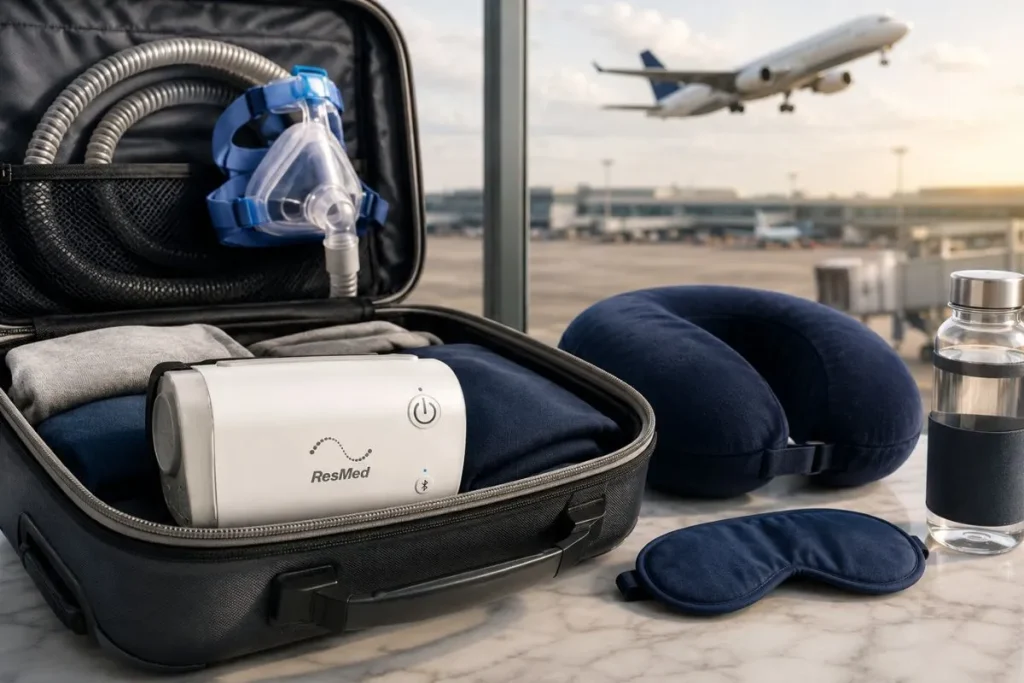
ResMed AirMini | 10.6 oz | HumidX waterless | DC cable / separate pack | App users, feature-rich |
Transcend Micro 510 | < 0.5 lb | None built-in | Transcend Travel Battery | Ultra-compact priority |
Breas Z2 Auto | 7.9 oz | Optional | PowerShell integrated | All-in-one convenience |
The ResMed AirMini is the most polished pick for users who want a compact but full-featured ecosystem. Its biggest advantage is the brand maturity and app-based convenience, while the downside is that it depends on waterless humidification and accessory compatibility rather than a traditional built-in humidifier.
The Transcend Micro 510 is the smallest-feeling option and is built for travelers who care most about size savings. It is a strong choice for backpacks, carry-ons, and minimalist packing, but the tradeoff is that you are buying into a stripped-down travel-first experience rather than a home-machine replacement.
The Breas Z2 Auto sits in the convenience middle ground. Its appeal is the integrated travel setup and optional power solution, while the main limitation is that it is still a specialist device, so buyers should compare accessories, noise, and battery needs carefully before choosing.
Travel CPAP Battery Guide — Power Solutions for Long Flights
There is no actual FAA rule that states a “4-hour rule,” but this is the airline policy concept requiring enough battery power typically for a flight plus a safety buffer as well. For example, a common requirement is 150% the expected flight time, so an 8 hour flight may result in a battery capable of around 12 hours of actual runtime. The buffer is important because cabin power can not be taken for granted and a delay can turn an occasional manageable flight into a habitually overnight, chronic power problem.
When you buy a battery, consider watt-hours, not marketing mumbo-jumbo. According to the FAA, you can usually take lithium-ion batteries up to 100 Wh; those between 101 and 160 Wh may be accepted with airline approval, but anything over that is not allowed in the cabin.
Spare lithium batteries must only be carried in carry-on baggage with terminals protected against short circuit.
There are two prevalent approaches for battery storage. Device-specific solutions are tailored to a specific CPAP platform; however, universal batteries can be used for multiple travel devices provided that the proper cables and voltage leading are utilized. If your device supports it, switch off humidification during flight for better runtime; that can significantly increase battery longevity.
The DC lead could break up a perfect travel arrangement, so always carry the backup cable as well.
Packing Your CPAP for Air Travel — 8 Practical Tips
- Always carry it on, never check it. Checked bags get lost, delayed, or crushed, and your CPAP is too important to gamble with.
- Use a dedicated CPAP travel case. It keeps parts organized and makes screening easier.
- Empty the humidifier before you leave. Water leaks can damage the machine and make packing messy.
- Pack distilled water separately or buy it at your destination. Tap water can leave deposits in the humidifier.
- Bring a universal power adapter. Most CPAPs support dual voltage, but plugs still vary by country.
- Download the companion app before travel. It helps with settings, troubleshooting, and therapy tracking.
- Keep your prescription in your travel wallet. A paper copy is still useful if your phone dies or if officials ask for proof.
- For international trips, be ready to explain the device if asked at customs. A prescription or medical note helps confirm it is for personal medical use.
FAQ's
Can I bring my CPAP on an airplane?
Yes, you can bring a CPAP on an airplane, and it usually does not count against your carry-on limit because it is treated as a medical device. The safest approach is to keep it in the cabin, not checked baggage, so you avoid damage, loss, or being separated from treatment during the trip. Most major airlines allow this in practice.
What are the TSA regulations for CPAP machines when flying?
The TSA allows CPAP machines through airport security as medical devices, and they are typically screened outside the bag in a separate bin. Officers may swab the machine for residue, which is normal. If you carry distilled water or a liquid accessory separately, that item still has to follow liquid rules, but the machine itself is permitted.
What is the 4-hour rule for CPAP?
The “4-hour rule” is not an official FAA regulation; it is an airline policy shorthand for having enough battery power for the flight plus a buffer. A common standard is to plan for about 150% of the flight time, so an 8-hour flight may call for around 12 hours of battery runtime. That cushion matters when flights are delayed or your seat power does not work.
Do I need a letter from my doctor to take a CPAP on a plane?
No, you do not need a doctor’s letter to pass TSA screening with a CPAP. Still, carrying a letter or prescription is a smart move because some airlines, especially on international routes, may ask for documentation. A short medical note can prevent delays and makes it easier to explain the device if anyone questions it.
Can I use my CPAP machine during a flight?
Yes, many airlines permit in-flight CPAP use, but you usually need to notify them in advance and follow their medical-device process. Some aircraft have seat power, though availability depends on the cabin and route, and battery power is still the most reliable option. If you plan to sleep midair, an aisle or bulkhead seat gives you more room to manage the setup.
Are travel CPAP machines worth buying?
Travel CPAPs are worth buying if you fly frequently, take long-haul trips, or want a lighter setup that is easier to pack and carry. If you only travel occasionally, your home machine may still be enough, especially because it already qualifies as a medical carry-on. The main tradeoff is convenience versus cost, since travel machines usually run several hundred dollars.
What are the best portable CPAP machines for air travel in 2026?
The strongest portable picks in 2026 are the ResMed AirMini, Transcend Micro 510, and Breas Z2 Auto. The AirMini is the most feature-rich, the Transcend Micro 510 is the tiniest, and the Breas Z2 Auto offers a compact all-in-one feel. The best choice depends on whether you value app features, minimum weight, or simpler battery integration.
Where can I buy a travel CPAP and travel accessories for flying?
You can buy travel CPAP machines, battery packs, waterless humidification accessories, and travel cases from specialist CPAP retailers such as CPAPRX. A good retailer should help you match the machine, battery, and cable to your travel style instead of just selling a box. That matters because the best setup is the one that fits your flights, your luggage, and your therapy routine.
Final Words
Flying with a CPAP is easier than most people expect, as long as you understand TSA screening, airline notice requirements, battery limits, and the practical difference between a home machine and a compact travel model.
The smartest setup is usually the one that matches how often you travel, how long your flights are, and whether you want the lightest possible bag or the most feature-rich experience.
Flying with a CPAP is easier than most people expect — millions of CPAPrx users travel by air every year without issues. If you are ready to travel lighter, explore compact travel CPAP machines and battery bundles built for frequent flyers.